riff’s rants & raves: spring distractions on and off broadway


Okieriete Onaodowan and Aigner Mizzelle star as battling siblings in The Monsters (photo © T. Charles Erickson)
Spring is the busiest time of the year for theater critics, as dozens of shows open just in time to qualify for such awards as the Tonys and the Drama Desks; the deadline for the 2025–26 season is April 26. Thus, I will see more than twenty shows each month, in March, April, and May. It can get overwhelming, but it is also utterly thrilling.
On March 11, I went to City Center to see writer-director Ngozi Anyanwu’s The Monsters at MTC’s Stage 1. However, when I got there, I looked up to see that Bigfoot! was playing there. My instant thought was that I was at the wrong theater, which has happened a few times before, no matter how careful I am with my calendar. Fortunately, I was at the right place: The Monsters was at MTC’s smaller Stage II at City Center. I would be back the next night to see Bigfoot!
MTC’s Monster Mash doubleheader turned out to be a mixed bag. The Monsters (through March 22) is a sensationally vibrant and powerful play about sibling love and rivalry. Josephine, known as Lil (Aigner Mizzelle), surprises her older brother, Big (Okieriete Onaodowan), after his latest MMA (Mixed Martial Arts) match. They haven’t seen each other in sixteen years; she’s nearly thirty, while he’ll be forty soon.
He doesn’t recognize her at first. “You might have remembered me from such places as your childhood and shit,” she says. An outgoing person who adds booze to her lunch-break soft drink, she has recently moved into the neighborhood and works at a local Applebee’s; a dour, private man, he is concerned about remaining the regional MMA champion, his belt glimmering on the wall. She wants to reconnect; he wants to be left alone.
For ninety-five minutes, they battle psychologically and physically, occasionally going back to the past, when they were kids who had fun together. Soon he is training her to focus her boundless energy into becoming an MMA fighter as well, but it eventually drives a wedge between them they may not recover from. The title refers to the monster that is inside all of us, one that we keep bottled up, perhaps with good reason.
Mizzelle and Onaodowan are mesmerizing as the siblings; it’s one of the most physical shows you’ll ever see, taking place on a spare set with a taped-off center that represents the ring for the matches — and the rest of life.
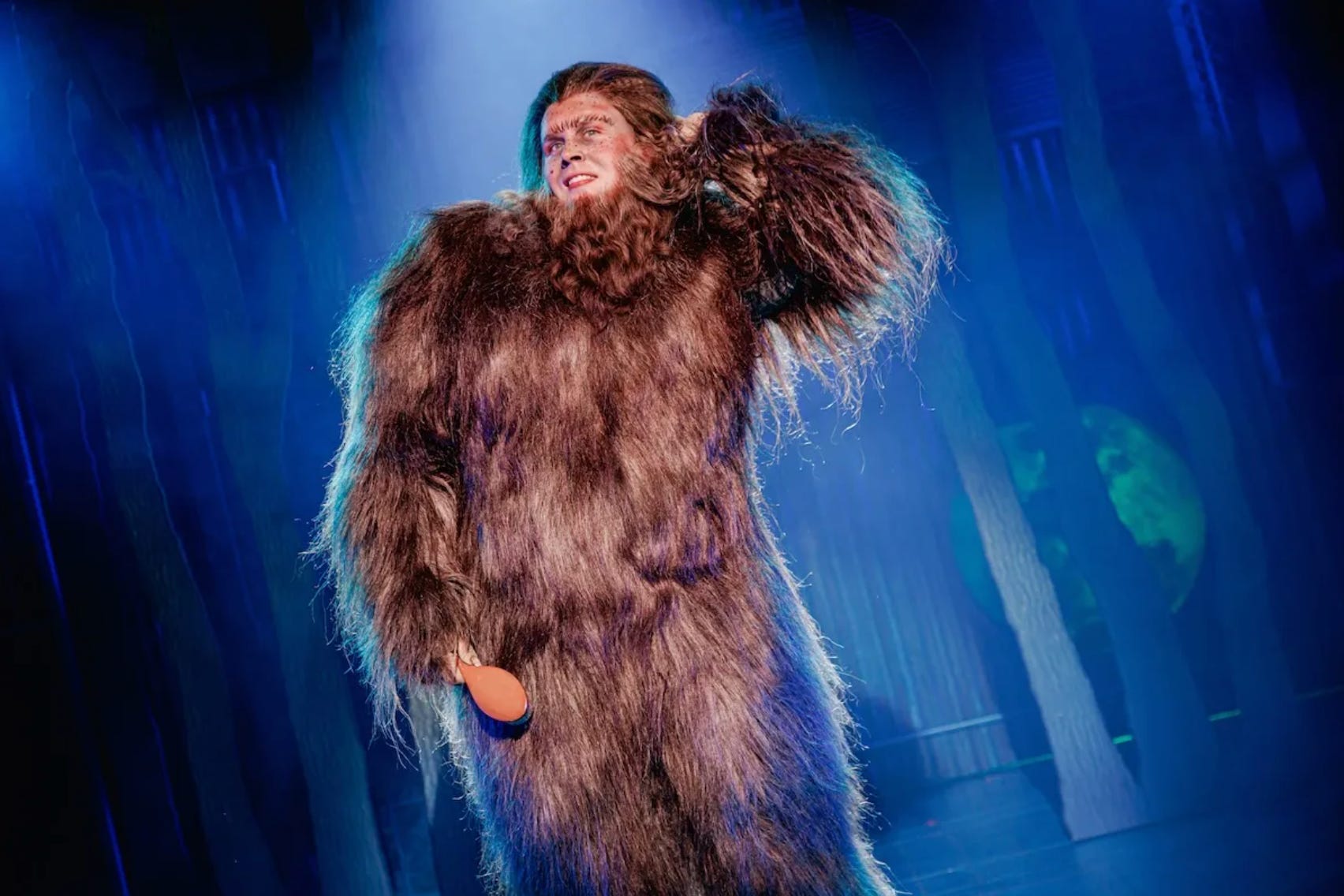
Grey Henson is adorable as Bigfoot in new musical (photo © Marc J. Franklin)
I returned to City Center the next night to check out another monster, the legendary Bigfoot (through April 26). As played by Tony and Drama Desk nominee Grey Henson (Mean Girls, Elf), the hairy Sasquatch is absolutely adorable, a mix of Chewbacca from Star Wars and Harry from Harry and the Hendersons.
Bigfoot lives alone in the woods outside the small town of Muddirt; the only people he sees are his doctor (Jason Tam) and his mother, Francine (Crystal Lucas-Perry), who protect him from being spotted. Bigfoot, whose father was a carnie who had sex with Francine next to the nearby nuclear power plant, is a gentle soul who loves everyone and wants to do good.
“Mama taught me that you help people because it’s the right thing to do, even if it’s in secret because those people have been traumatized by a corrupt system to the point that they’ve become reliably violent and easily manipulated by the very people that traumatize them,” Bigfoot tells Joanne (Katerina McCrimmon), a hunter seeking to capture him.
Meanwhile, the corrupt mayor (usually Alex Moffat, but I saw understudy Mike Millan) is trying to make a shady deal with a greedy CEO (Jade Jones) to tear down the woods and replace them with a water park that nobody but them wants.
Whenever Bigfoot is onstage and not singing, the show has a sweet-natured charm; however, the book, music, and lyrics, by Emmy and Tony nominee Amber Ruffin (Some Like It Hot, The Wiz) with David Schmoll (music) and Kevin Sciretta (book), are extremely disappointing. The slapstick comedy is far too over the top, the story is a mess, and the songs don’t add anything to the story, merely repeating what we already know. Director and choreographer Danny Mefford lets things get out of hand.
“Can I ask a question? If I may? What is it about me that makes you hate me so much?” Bigfoot asks.
I adore you, I would answer. And I don’t hate Bigfoot!, but . . .
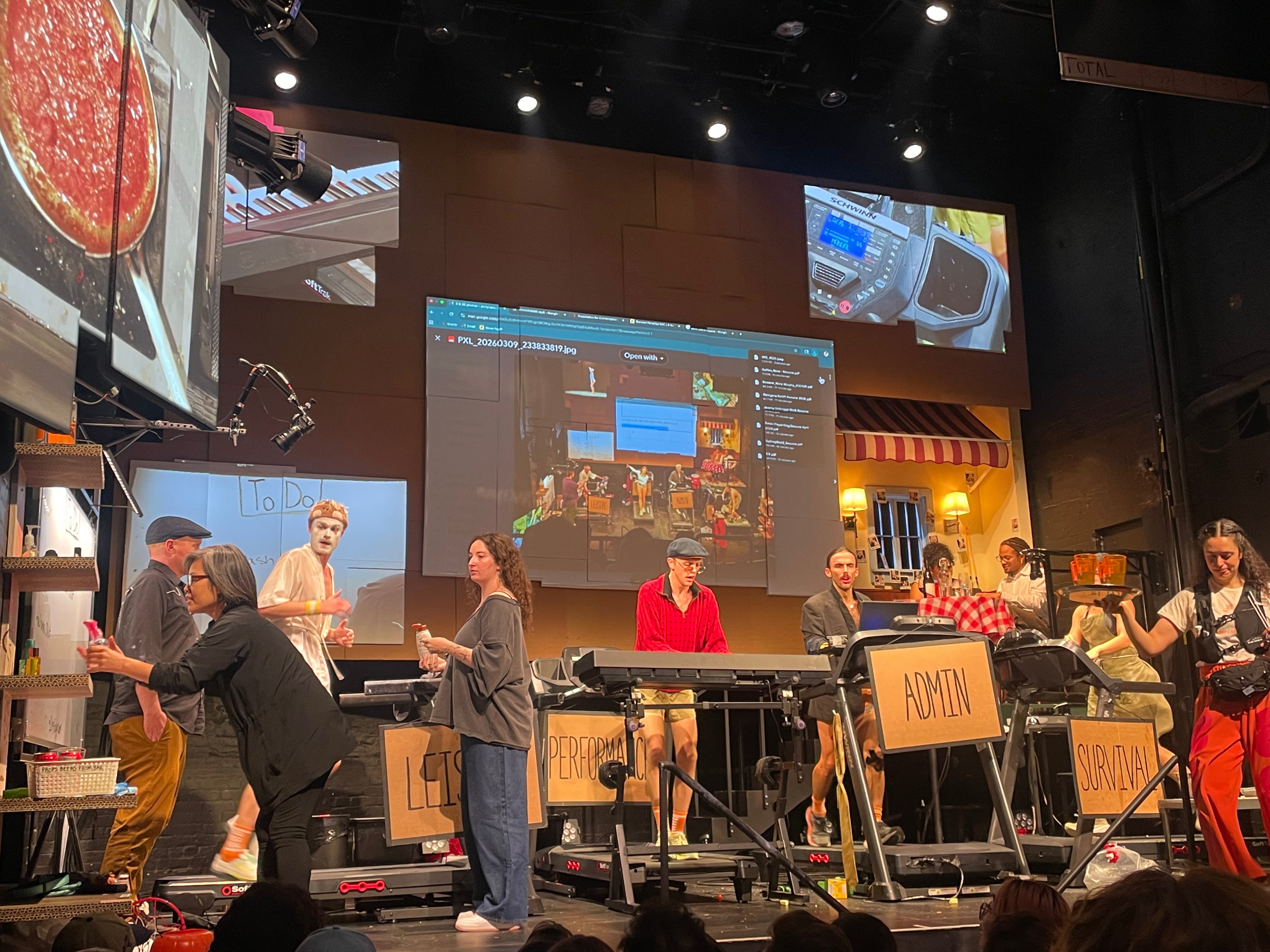
Burnout Paradise is an interactive marvel of a show, performed on treadmills (photo by twi-ny/mdr)
I mentioned above how physical The Monsters is; Burnout Paradise (through June 28) takes theater physicality to a whole new level.
When you enter the Astor Place Theatre, some of the actors are already on the bizarrely cluttered stage, going through warmups in preparation for a running time — and I do mean “running” — of seventy minutes. During this period, feel free to walk up and talk to them; they are friendly and ready to get you involved, because audience participation is a key element to the show.
Created by the Australian collective Pony Cam, Burnout Paradise is centered around four treadmills where the performers do twelve-minute shifts, attempting to complete specific tasks, then switching places. I saw Claire Bird, William Strom, Dominic Weintraub, and Hugo Williams, with Ava Campbell serving as host and Gatorade purveyor. With the audience’s assistance, the troupe tries to make a romantic Italian dinner for two guests (“Survival”), submit a grant application for an outdoor performance in Washington Square Park (“Admin”), deliver twelve-minute solos (“Performance”), and finish a long list of prompts on a whiteboard, from “shoot hoops” and “clean teeth” to “trick or treat” and “shave” (“Leisure”). Screens throughout the theater offer close-up views, along with some surprises.
No one is forced to participate; it is all by volunteer, but dozens and dozens of audience member will enthusiastically get in on the act. I yelled out for “duck hunt” and found myself shooting long, soft bullets at a cutout duck held by Bird while she was moving on the treadmill.
At the end of each segment, Campbell adds up the group distance; if the final mileage does not reach a certain number, you can ask for a refund. (I can’t imagine anyone ever has.)
The night I went, Bird announced early that, after eighteen shows, she “was feeling it.” But that didn’t stop her or the rest of the company, and by the end, I was feeling it too.
And it felt awesome.
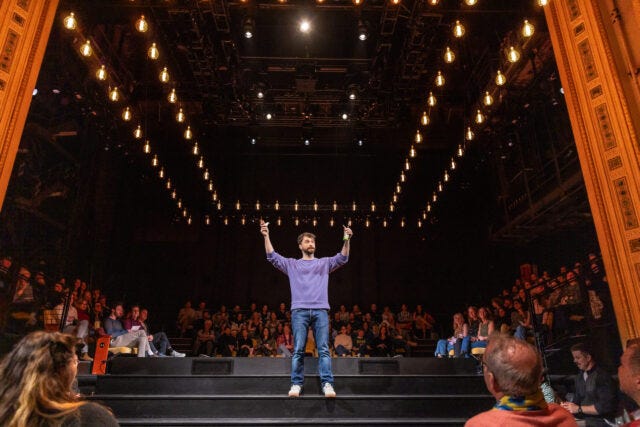
Daniel Radcliffe interacts with the audience in Every Brilliant Thing (photo by Matthew Murphy)
Audience participation is also at the heart of Every Brilliant Thing, at the Hudson Theater through May 24.
I previously saw the sixty-five-minute play at the Barrow Street Theatre in March 2015, starring Jonny Donahoe, who gets a smaller-font writing credit with the larger-font Duncan Macmillan, who based the show on his short story “Sleeve Notes.” George Perrin directed that version, but the Broadway iteration is helmed by Macmillan and Jeremy Herrin, who directed Macmillan’s People, Places & Things.
Be sure to arrive early, because when the doors open, Tony winner and four-time Drama Desk nominee Daniel Radcliffe (Privacy, The Cripple of Inishmaan) is roaming around the theater, handing out prompts and speaking with various audience members, both in the regular seating as well as three rows of rafters on the stage. He is looking for people to call out items from a list and to play several important roles in the character’s life. I desperately wanted to get a prompt but came away empty-handed, although that did not affect my sheer enjoyment of the dazzling show.
The play starts with Radcliffe, as an unnamed narrator, announcing, “The list began after her first attempt. A list of everything brilliant about the world. Everything worth living for.” He then calls out numbers, and each audience member who has that prompt answers. “1. Ice cream. 2. Water fights. 3. Staying up past your bedtime and being allowed to watch TV. 4. Things with stripes. 5. Rollercoasters. 6. Super Mario. 7. People falling over.”
The narrator explains that he started the list on November 9, 1996, when he was seven years old and was told by his father that his mother had hurt herself.
The narrator re-creates that scene as well as others from his past, about his dog (Indiana Bones), a librarian with a sock puppet, and a fellow student he is interested in at university, all involving the audience in one way or another. The success of the play depends on the audience members’ performances and Radcliffe’s ability to improvise if things don’t go quite as expected; the night I went, both were in top form.
As I wrote in my 2015 review, through it all, Macmillan and Donahoe explore the fragile nature of depression and suicide, from how families deal with mental illness to the hyper-controlled way it’s depicted in the media. “If you live a long life and get to the end of it without ever once feeling crushingly depressed, then you probably haven’t been paying attention,” the narrator says.
Every Brilliant Thing is essentially about making connections, both in life and in theater, being part of something that is bigger than yourself. It’s tragedy and comedy of the highest order, an unforgettable experience that just might lead to your jotting down some of the things that make your life worth living. And the first one is very likely to be: Every Brilliant Thing.
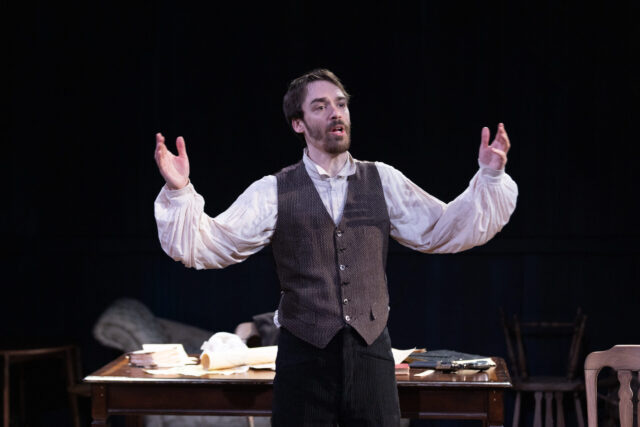
Zachary Desmond stars as the title character in stellar production of Ivanov (photo by Bronwen Sharp)
When you enter the West End Theatre to see New American Ensemble’s stirring adaptation of Anton Chekhov’s first produced play, Ivanov, the protagonist is also already there. But instead of running around the theater like Radcliffe, Zachary Desmond is standing stock-still on a rectangular wooden platform just a few inches off the floor, a thick tree branch hovering above him; he is staring into the distance as if he’s at the end of his rope — which, we soon find out, he is, at least in his own mind.
It’s a tiny black-box space, with seventy-four rafter seats arranged in a semicircle of four rows each. The platform is surrounded by wood chips, making the audience feel like it’s immediately stepping into the world of the play. However, not everyone seems to notice as they continue conversations and check their phones while Desmond doesn’t move.
Soon he is startled by his distant cousin, Misha Borkin (an exuberant Mike Labbadia), and cries out, “Misha, for God’s sake! You scared the hell out of me! I’m upset as it is, and you come around playing your stupid tricks! All right, I’m scared. Does that make you happy?”
It’s a splendid introduction to Ivanov, a pathetic, frightened, weak-willed wisp of a man who is broke, has fallen out of love with his ailing wife, and sees no future for him. He owes nine thousand rubles to the ruthless Zinaida Lebedev (Mary Bacon) and her husband, Pavel (Paul Niebanck), the president of the County Council. His wife, Anna (a tender Quinn Jackson), has tuberculosis and is being treated by the humorless Dr. Yevgeny Lvov (Lambert Tamin), who regularly chastises Ivanov for his lack of concern for Anna while falling for her himself.
Misha is looking to borrow 2,300 rubles from anyone so he can build a dam and charge people to cross a river. “That’s extortion,” Ivanov tells him derisively.
Ivanov is a man of principles, but that doesn’t prevent him from becoming interested in the Lebedevs’ daughter, Sasha (Maya Shoham), even as his wife professes her love despite her failing health. But Ivanov is determined not to be happy and not to accept anyone’s help.
Beautifully directed by Michael DeFilippis using Paul Schmidt’s late-1990s translation, Ivanov is one of the surprises of the season (and has now been extended through April 12). I was so drawn in that I was able to ignore the man sitting in the row in front of me, to my right, as he absentmindedly fluttered the glossy cardboard program in his hand, creating the kind of distraction that can make me nuts, especially when it caught the light.
The only other time I saw Ivanov, in 2018, a terrific production presented in Russian at City Center by the State Theatre of Nations, I was distracted by an opening-night crowd of many Russians who chatted during the show, got up and down incessantly to change seats and use the facilities, and let their phones go off constantly during the performance, without fear or embarrassment.
Ashley Basille’s set, which includes a picnic table, desk, chairs, and a slatted-wood balcony, is exemplary in its simplicity, and Adeline Santello’s period costumes are spot on. The cast, which also boasts a boisterous Ilia Volok (Our Class) as Count Shabelsky, Ivanov’s lecherous party-animal uncle, is excellent as we are immersed in this intense family drama of fading wealthy and power unfolding merely feet away.
New American Ensemble previously presented John Webster’s The Duchess of Malfi in 2024 and Anthony Clarvoe’s adaptation of Fyodor Dostoevsky’s The Brothers Karamazov last year; I can’t wait to see what they have in store next.
In the meantime, I will happily add Ivanov to my (mental) list of brilliant things.
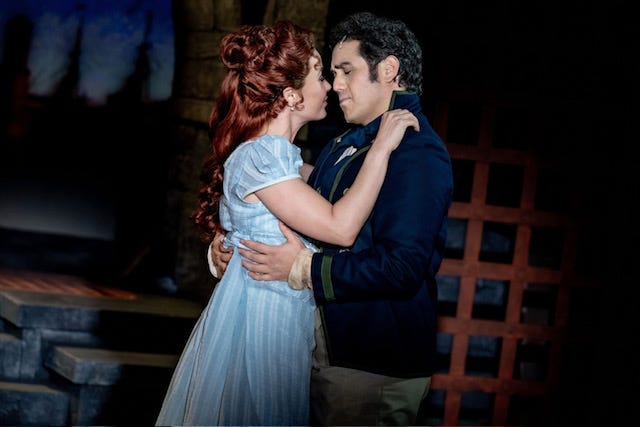
Sierra Boggess and Adam Jacobs star in world premiere of Monte Cristo (photo by Shawn Salley)
I encountered a new kind of distraction at the York’s world premiere of Monte Cristo, a musical based on Alexandre Dumas’s 1846 classic swashbuckling novel, The Count of Monte Cristo, and the 1868 play by Charles Fechter. Continuing at the Theater at St. Jean’s through April 5, the show is a tale of two acts.
The first half is sensational, a rousing tale of true love, deception, and revenge, set to fabulous songs; the book and lyrics are by Peter Kellogg, with music by Stephen Weiner, choreography by Marcos Santana, and direction by Peter Flynn.
After a short introductory scene, the ensemble rips into “Dangerous Times,” a gorgeous number in which various characters warn in a verse that sounds like it could be about what’s happening today, “These are dangerous times / Be careful whom you speak to / Someone over there is taking note / Someone’s writing down who your friends are / Someone is recording how you vote.”
After the captain of his ship dies unexpectedly, first mate Edmund Dantes (Adam Jacobs) detours to Elba to carry out the captain’s dying wish, that he deliver a letter to the exiled Napoleon Bonaparte (Eliseo Roman).
Upon returning home to Marseilles, Edmund is made captain of the Pharaon and proposes to his beloved, Mercedes (Drama Desk nominee Sierra Boggess), who accepts. However, before Edmund sets sail, Mercedes’s cousin, Fernand Mondego (Daniel Yearwood), who is in love with Mercedes, although she does not share his affection, conspires with Danglars (James Judy), who thought he should be named captain, to send a letter to royal prosecutor Gérard de Villefort (Tony and Dfama Desk nominee Norm Lewis) claiming that Edmund is guilty of treason. Villefort believes Edmund is innocent but sentences him to the dungeon when he realizes that his own father and career are in jeopardy if he frees Dantes.
In prison Edmund meets the crusty old Abbe Faria (Danny Rutigliano), who becomes his mentor as he plots his escape and revenge over the course of eighteen years. Little does he know that Mercedes has married Fernand and they have a son.
When he does get out and learns the truth, his plans to get even with those who wronged him become more complicated.
Everything worked in the first half, from the performances to Shawn Duah’s projections across Anne Mundell’s castle/dungeon set, from the central romance between Edmund and Mercedes to the comic relief supplied by Rutigliano as tavern owner Caderousse. Even my view was superb — the three seats in front of me were vacant.
However, nearly everything fell apart after intermission. Those three seats were now occupied by what appeared to be a husband and wife and their grown daughter. None of them could sit still; they frequently leaned into one another to whisper, pass around a Stanley Cup, and share two binoculars among them.
I ended up not freaking out about the constant distraction because of the stark decline in the quality of the show. The characters became more cardboard, new subplots dragged down the pace, the music was more conventional, the lyrics were melodramatic, and the comedy fell flat. It was like two different productions by two different companies.
It’s worth seeing for the first act alone; I never leave any show at intermission, nor do I recommend anyone doing that, but . . .
Although I wouldn’t call it a distraction, the first time I saw Ragtime I was laser focused on Rodd Cyrus as Harry Houdini; I attended the Lincoln Center production with my wife and several of her Wellesley classmates, one of whom is Rodd’s deservedly proud mother. In fact, his first words in the show, which features a book by Terrence McNally, music by Stephen Flaherty, and lyrics by Lynn Ahrens, are “He made his mother proud.” It made me think of my own mother; I remembered discussing the E. L. Doctorow novel with her and later watching the 1981 film together.
At the Vivian Beaumont, I saw two understudies, the excellent Billy Cohen as Tateh instead of Tony and Drama Desk winner Brandon Uranowitz, and Kerry Conte as Emma Goldman in place of Drama Desk and two-time Tony winner Shaina Taub. The second time, I saw Uranowitz as Tateh and Julie Benko as Goldman; Benko temporarily took over the role from Taub through March 29.
As much as I loved the show in November, it was even better in January. It has one of the greatest opening numbers in Broadway history, an electrifying beginning that introduces all the characters and identifies the three interlinking stories involving Eastern European immigrants, wealthy white suburbanites, and African Americans in Harlem.
This time Goldman, in the hands of Benko, seemed like a much more integral character, and Uranowitz brought a different dimension to Tateh. Cohen returned to the ensemble, where he portrays architect Stanford White, DA and future New York governor Charles S. Whitman, and others. All three actors take part in a scene that I will never forget because of the casting.
Tateh and his young daughter are selling silhouettes from a street cart when Goldman approaches him.
“Are you a rich man yet, Tateh?” the poet and activist says with more than a dose of cynicism, knowing that Tateh is determined to be a success in America but has not been having much luck.
“Don’t make fun,” he responds.
She tells him about an important rally happening that night in Union Square.
“I told you, Mrs. Goldman, no politics. My daughter needs to eat!” he declares.
At that moment a man, played by Cohen, walks up to Tateh and asks, “How much?”
Tateh initially ignores him, then says he will give him a discount, that it will be three cents instead of five.
“Not for a silhouette, you idiot Yid,” the man barks derisively. “How much for the little girl?”
Tateh attacks the man but is stopped by a policeman.
It’s an innately powerful scene, but it took on greater depth for me having previously seen Cohen as Tateh, an immigrant who would do anything for his daughter and was beyond insulted when a man assumed he was so desperate that he would sell his own child. Now Cohen was on the other side, and the impact of that switch offered a new perspective on what humans are capable of, a microcosm of what the show, exquisitely directed by Lear deBessonet, is essentially about.
As the Player says in Tom Stoppard’s Rosencrantz and Guildenstern Are Dead, “We do on stage things that are supposed to happen off. Which is a kind of integrity, if you look on every exit as being an entrance somewhere else.”
Welcome, spring — and here’s to yet more brilliant things, on- and offstage.
[For more Riff’s Rants & Raves on theater, including the new “ninety with twiny” insta-reviews, please follow Mark Rifkin on Facebook Reels and Instagram.]
"all right I'm scared. does that make you happy?!"